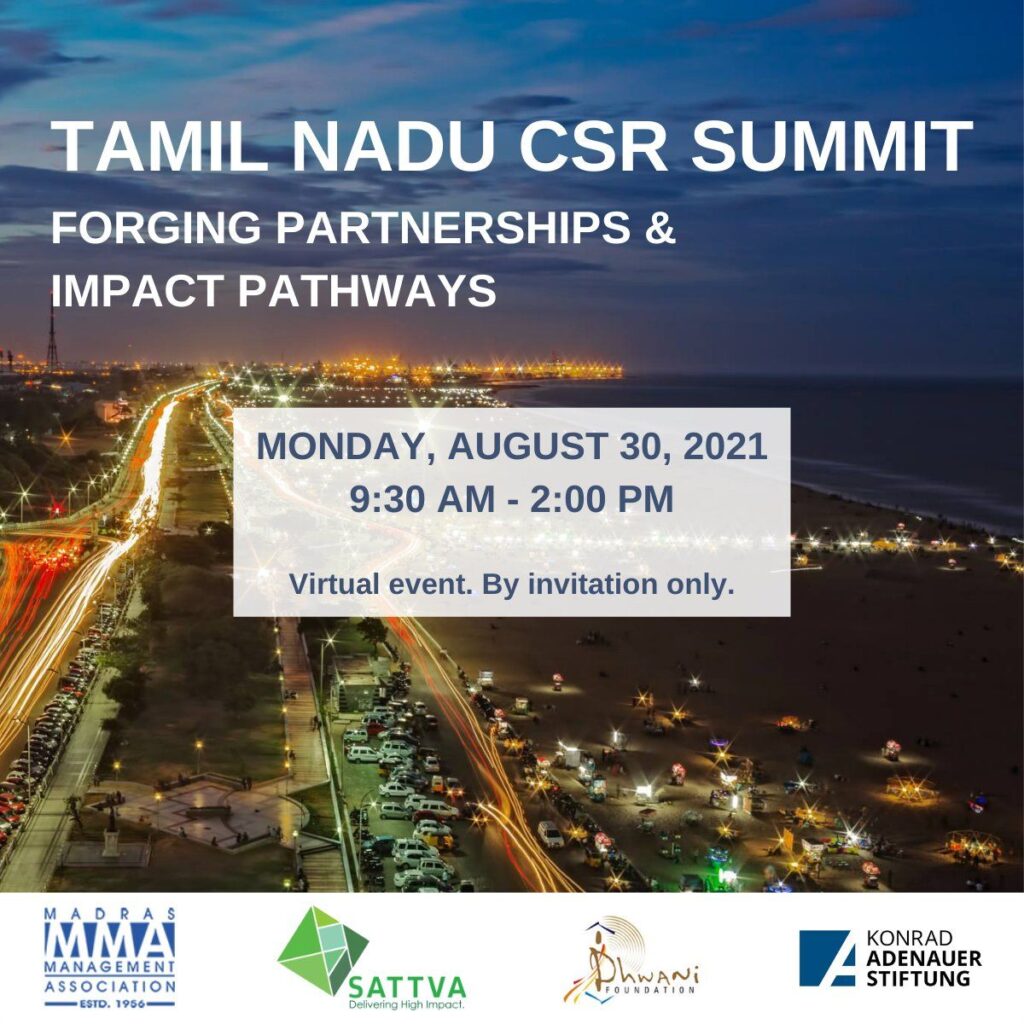
Tamil Nadu CSR Summit 2021 was held on 30th August, organised by Sattva, a consulting firm in the social impact sector, in partnership with Madras Management Association and Dhwani Foundation.
Event poster
Today, Tamil Nadu is India’s second-largest economy despite being only the sixth most populous state. Tamil Nadu is among the top-performing states on the United Nations Sustainable Development Goals (SDGs). It has a composite SDG score – which includes all key development sectors including health, education, employment, sanitation, energy among others – of 74 and ranks second on NITI Aayog’s SDG Index 2020-21.
The CSR mandate was made into law in 2014, and since then INR 92,605 crores of funding has been channeled by corporates towards development causes in the country. Tamil Nadu received INR 4094 crore from 2014-2020 and is the fourth highest CSR spender in India.
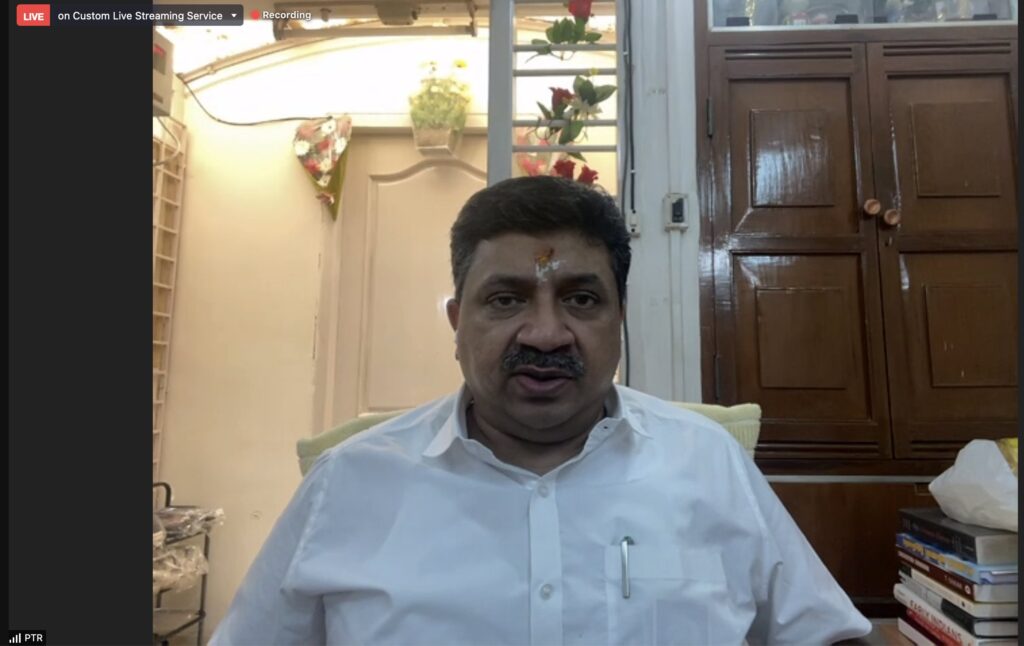
Dr Palanivel Thiaga Rajan (PTR), Minister for Finance & Human Resources Management, State Govt. of Tamil Nadu released the Tamil Nadu CSR Report which provides detailed information on where the over INR 4000 crores the State received in CSR funding since the inception of the mandate was spent, both at a district level and sector-wise.
Dr PTR observed, “the bulk of CSR are for projects in Chennai and Coimbatore, and little has been spent in Aspirational Districts.” He said it should be a wake-up call for big corporates to be more thoughtful, granular and detailed in their approach and activities.
Dr PTR speaking after the report release
In the last two years of 2018-2019 and 2019-2020, the state received over INR 800 crore each from the different corporates in the country. Companies headquartered in Tamil Nadu played a key role, with 72%of CSR funds received coming from them.
Key insights from the report :
The top three funding industries are BFSI, manufacturing and energy
Chennai received the bulk of CSR outlays at close to 25%, with Vellore and Coimbatore at little over 6% and 5% respectively
NITI Aayog recognised aspirational districts – Ramanathapuram and Virudhanagar – which are yet to meet many of the markers as per the SDGs received less than one percent outlay across the last six years
The three districts of Ariyalur, Tenkasi and Tirupattur received none at all
Following the pan India trend, education was the most preferred segment which the organisations supported, with healthcare and rural development coming in the second and third place
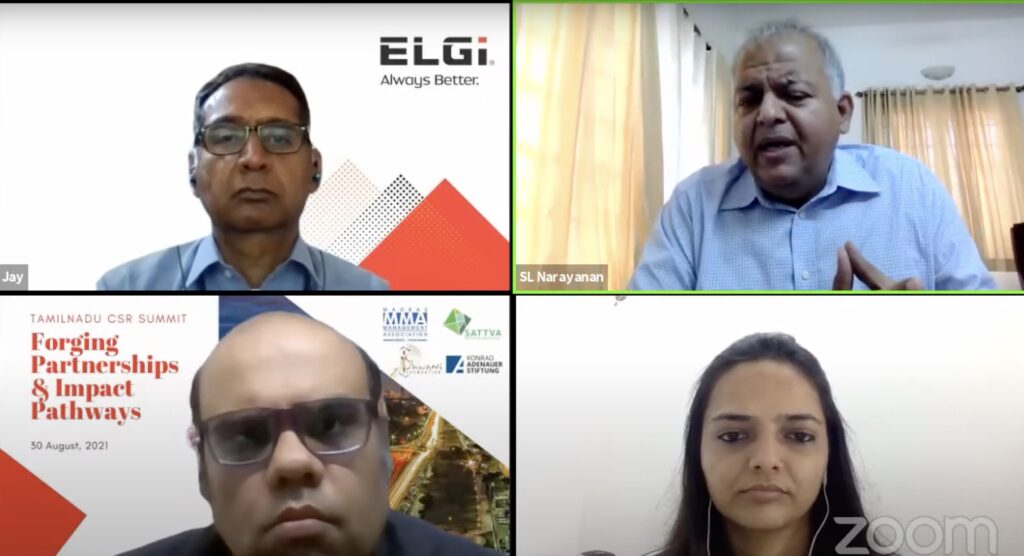
Panel discussion on Evolution of CSR
The event saw panel discussions on the Evolution of CSR, Enabling innovations and best practices in Social Impact, and Facilitating effective cross-sectoral and localized partnerships for scaled and sustainable impact. Participants included leading corporate leaders and representatives from NGOs and Foundations – Ashok Leyland, ELGi Equipments, Cognizant Foundation, Grundfos India, IIT Madras, Lend a Hand India, NSE Foundation, Saint Gobain, Samunnati, SUN Group and Thendral Movement.
Dhwani Foundation’s Executive Director KN Gopinath shared concluding thoughts, “It is time to deliberate how we can bring data and people together to ensure more impact in TamilNadu, with the government, non-profits and CSR organisations working together.”
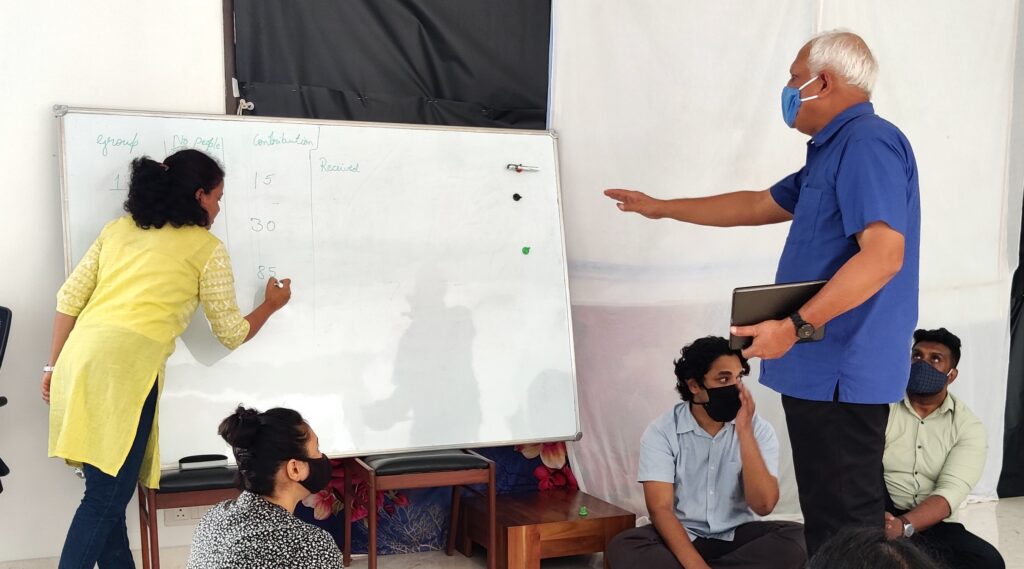
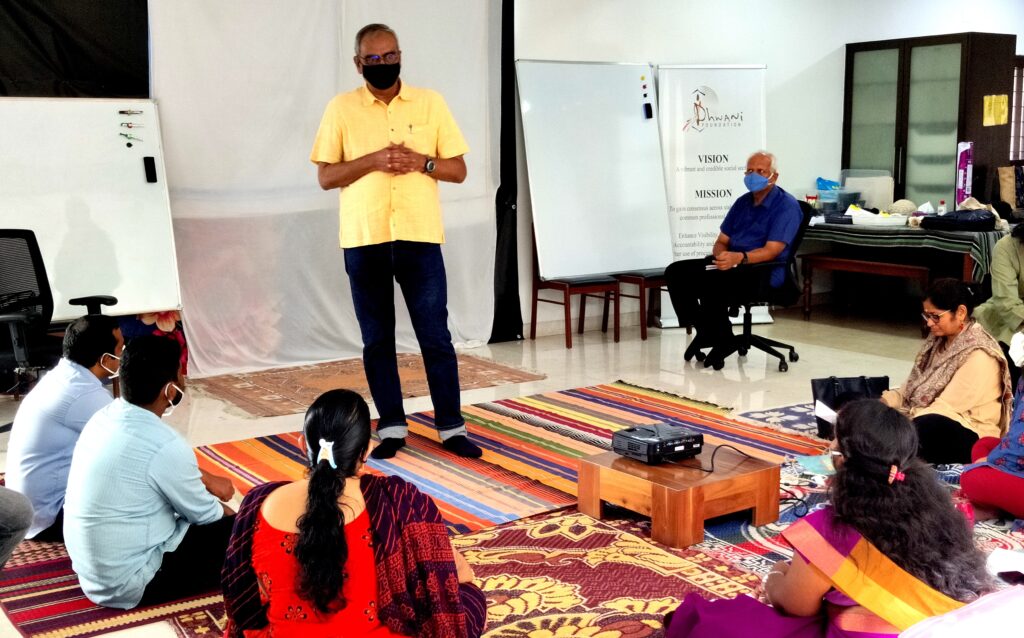
Renowned trainer RK Surdeo conducted an experiential session on Train the Trainer for the Dhwani Foundation Team. The programme was meant to help participants conceptualise, elaborate, and adapt as they deliver training interventions, aligned to development goals.
An exercise at the workshop
The three-day hands-on session was very engaging and valuable in giving the team a new perspective on training and facilitation. Training is a powerful tool in the social development space. And it is an essential skill that any of us can develop, to have a positive impact on our work.
The primary purpose of “Training” is to “influence” – it is not to showcase the knowledge of the trainer, but to fulfill the need of the participants and the larger community. Training needs to be grounded in social reality.
Informed by his rich experience gained over decades of working with NGOs, RK shared inputs on methods of training, how people learn, and understanding the needs of participants, as well as other stakeholders like organisers, partners, and community. He used simulations, exercises, reflections, group discussions, and connected the participants’ actions to real life.
Presenting our learnings
The preparatory work for a training programme is critical to the success of the programme. The plan needs to include the methodology, learning cycles, props, etc. Collaboration, communication, and coordination are critical elements. The team also realised that training needs to be followed by debriefing and group analysis.
The team gained new insights about training and its role in the social sector, and left with a resolve to internalise the knowledge gained in our own work!
As part of our Covid Lasika Aandolan programme, Dhwani Foundation is partnering with the Government of Karnataka and a network of NGOs to set up protocols, provide training and help in outreach for the COVID-19 vaccination drive in various districts of the state. This programme targets a population of 3.6 crores across the state.
On 25th June, 2021, the booklet with the set of guidelines – Margadarshike was released by Shri Eshwarappa, RDPR Minister at Shivamogga, Karnataka.
Guidelines for CVODI-19 vaccination drive – Margadarshike released by Shri Eshwarappa, RDPR Minister at Shivamogga.
The Standard Operating Procedure explains the goals and purpose of the drive, details out the process, roles and responsibilities of government officials at District, Taluka, Gram Panchayat level in carrying out the vaccination drive in coordination with the departments of Health, and Women and Child Welfare, as well as healthcare institutions at grassroots level. It serves as a handbook and reference guide for government officials, frontline workers for conducting awareness programs, registration and protocols to be followed in the vaccination centres. Based on the operational guidelines brought out by the MoHFW, the short and simplified version is currently available in Kannada.
Would you like to use your knowledge and skills to help non-profit organisations doing impactful work on the ground? The Updeshak Fellowship is for you!
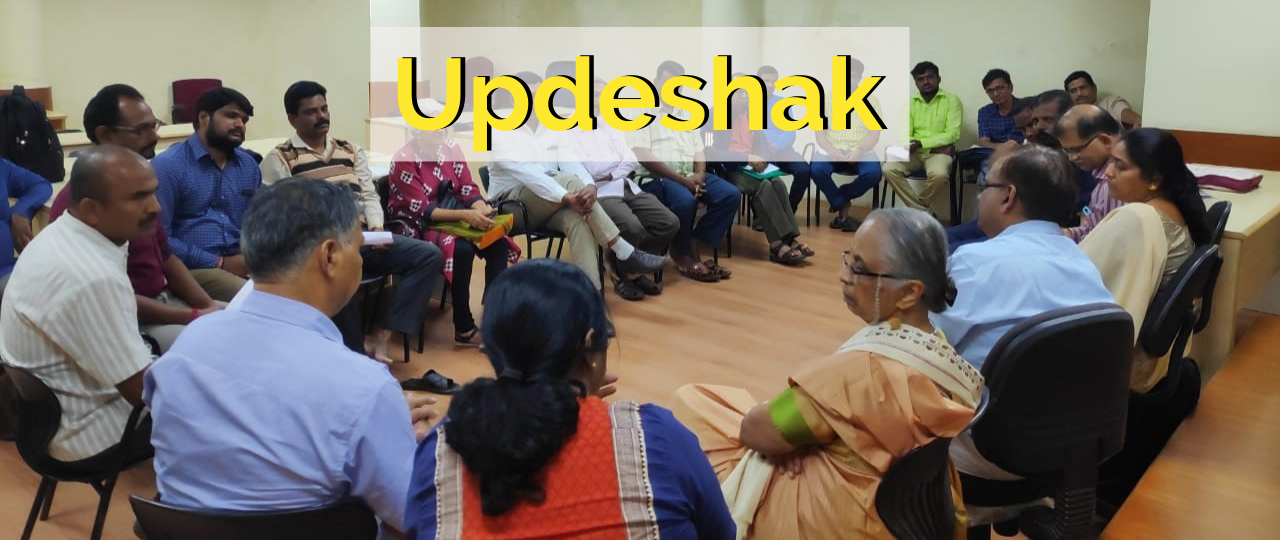
Dhwani Foundation has launched the Updeshak programme for our NGO partners in Tamilnadu. Updeshak programme helps identify, induct and mentor volunteers from professional and corporate sectors, to create a pool of independent board members to enhance governance in the social sector.
The fellowship is a great opportunity for professionals, entrepreneurs, people from the corporate world, and retired government officials to serve the social sector by becoming advisors and board members of a non-profit.
We invite applications from interested volunteers, especially mid-level and senior people in fields like IT, accounting, legal, medical, academia, banking, social sector, and governance. We encourage women applicants in particular, to bring diversity to the boards. Volunteers should be able to communicate in Tamil, and willing to travel to the NGO location in Tamil Nadu to attend board meetings every quarter.
We are now inviting applications from interested volunteers to become advisors and board members of NGOs based in Tamil Nadu. For more details, check the Updeshak Tamil Nadu brochure.
With the Covid pandemic outbreak and the subsequent lockdown, our team had stopped travelling and meeting our NGO partners in person for many months. In Dec 2020, we travelled to Raichur to meet our North Karnataka program partners.
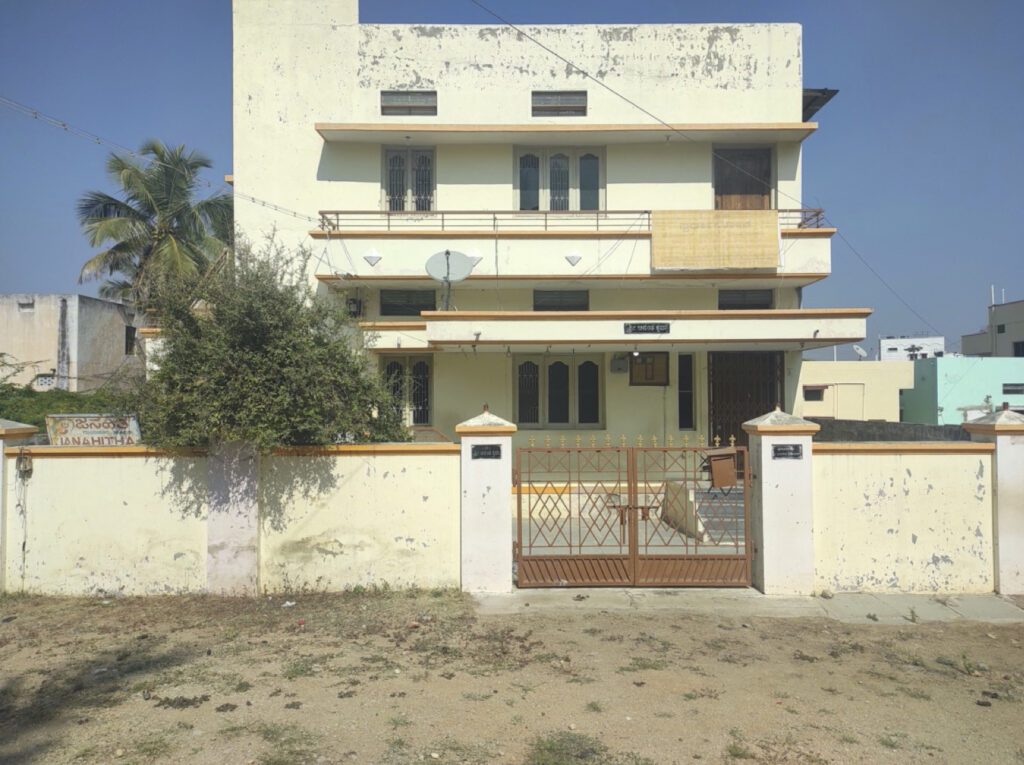
We landed up at the office of one of the NGOs, Jagruthi (name changed) to find a deserted building in a dilapidated condition.
A empty building that once housed an NGO.
This NGO had been very active earlier, but the founder Mohan (name changed) had fallen ill. He was in his sixties and while he was hoping to get better and revive operations, we were not so sure. Small grassroot organisations are often led and managed by one person, and it was not uncommon to see board members and other staff not having a say in the execution. Mohan did not trust the board members and suspected them of having embezzled funds.
It was sad to see an organisation which had been very impactful in the community, with a large number of beneficiaries for so many years getting into such a situation. This is a common story of many grassroot organisations led by individuals, especially those without a functional and effective board.
In a district like Raichur, which sees some of the lowest social and human development indices, the work of non-profit organisations and community workers are critical. They work on raising social awareness, helping implement programmes in education, health and rights, and ensuring public services reach the most marginalised. Covid19 pandemic has thrown the work of countless such organisations out of gear.
Another NGO Suvidha had stopped operations in May 2020 as their main funding agency had stopped grants. They worked to prevent and stop child marriages and child labour which is prevalent to this day in rural Raichur. The founder Siddappa says that he would come across one complaint of child marriage/labour almost every day in the region. Their donor informed them that their priorities for FY 2021 have moved to Covid19 relief.
Last summer Dhwani Foundation had conducted a study on the possible impact of COVID19 in the Social Sector. We spoke to 56 respondents – key stakeholders across the NGO, donor and support communities. We found the impact of COVID 19 on the social sector is long-term and will last till 2022. Funding to NGOs has reduced by around half in the 2020-21, smaller NGOs have shut or are barely managing to survive.
Most programs had been affected and there is pressure on the rural system, with returned migrants struggling with no livelihood options. Anxiety and stress were having ripple effects. Several important social, educational, and psychological issues that need the required attention may not be the focus in the short term. We realised that could lead to unique challenges that society will need to address in the long run.
New and amended regulations are now adding to NGOs’ already long list of challenges. The FCRA Act amendment prohibiting large NGOs/funders giving subgrants to smaller NGOs for implementation was another setback to organisations like Suvidha. Suvidha had been fully dependent on such funds to run their operations, pay salaries to their ten staff members and reach out to 100+ villages to stop child marriages and child labour.
Only founder Siddappa and two colleagues are left in the organisation. They are now running a local newspaper. With a circulation of 5000 copies, its ad revenue is their sole income. Their community work has come to a standstill. The funder has promised some support. But it remains to be seen if that can help revive the operations to its original scale and help reach out to the community for such an important but unpopular work.
Siddappa has been an activist fighting for child rights for over 30 years and with his connections across the region, he has been at least able to mobilise resources from the community and from the local donors to run awareness camps on child marriages and labour prevention. The problem of child marriages is so severe in this region that a child helpline worker in the economically backward Raichur district has received over 100 complaints in the last two months!
The third NGO we visited was at Sindhanur, 70km away from Raichur. Light of Hope runs an orphanage and a school for children of local agricultural labourers and single parents from marginalised communities. The school has had no children for the last 9 months due to the lockdown rules. After Covid19 struck, they have been engaged in relief activity for the community. They supported more than 200 families with groceries and personal hygiene kits.
There is no clarity on when schools can reopen. The orphanage/foster care home that once used to support around 70 children in residence now has just ten children as many of them went to their villages to stay with relatives/extended families. The future of the NGO is in question. The founder John is mulling over what can be done to support local families struggling to meet their basic needs.
NGOs have little or no capacity to provide required services in the new normal. Donors are de-prioritising rights-based activities.
For us, these three NGOs represent the condition of many thousands of NGOs across the country — those that are small and medium in size, based in rural remote areas and serving the most marginalised communities. These NGOs are the ones that do not attract the talent required to work on the hardest social issues plaguing society to this day.
Siddappa tells me, “Sir, we have courage to work in these areas but do not have enough skills and many in the city have enough skills but lack courage to come here and work”.
The way forward
There is a critical need for non-profit community organisations to build the right strategy. They need to improve fundraising process, incorporating efficiency and cost-effectiveness in proposals. Self-sustainable projects and local fundraising needs to be explored for revenue generation. Research, data analysis and reporting will be a basic need.
Technology is now critical for being effective. It also ensures continuity in work. NGO networks and collectives will be key to being relevant to the communities they serve and in influencing policy.
NGOs and CBOs are an essential cog in the wheel of the development. It is even more important than earlier that all stakeholders in the sector, including the grassroots organisations, donor agencies, foundations, social research institutions and academia, and governments come together to ensure we can collectively tackle the multiple challenges of our society.
Koushik Yanamandram is a Programme Manager at Dhwani Foundation.
Note: Current enrollment in and around Bangalore and North Karnataka regions only
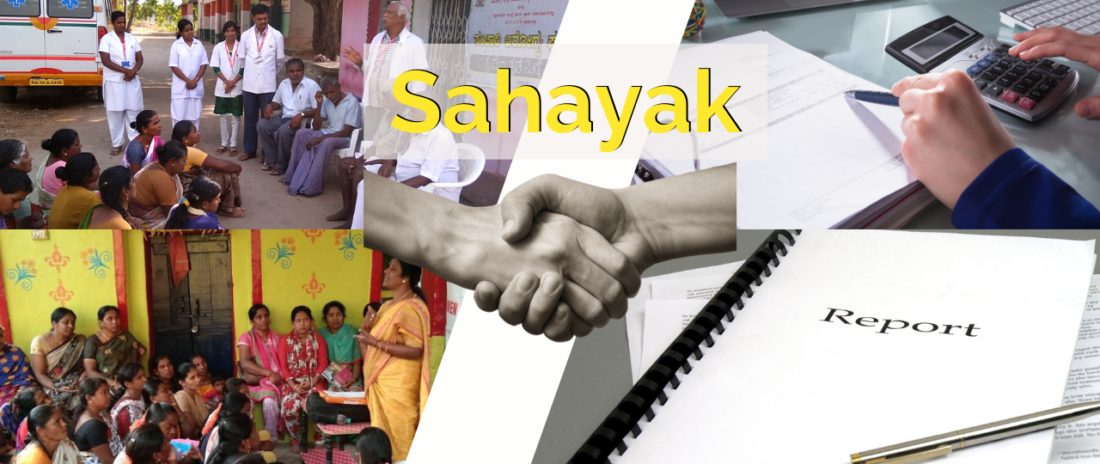
Sahayak from Dhwani Foundation is pleased to announce the launch of Non-Domain outsourced services for NGO’s. At Dhwani, we have surveyed over 100 various stakeholders in the social sector – CSR, Donors, Consultants, Government, Academics, Think Tanks, Resource Persons, NGOs, and came up with a list of 161 parameters that make an ideal NGO.
We offer to undertake your tasks and processes covering F&A, Compliance, HR and MIS to bring you the best practices by professionals to make your NGO an ideally administered NGO
Building trust by maintaining the highest standards of record-keeping and process management!
Service outcomes for your NGO:
Compliance : Sahayak will fulfill and update all Legal compliances and regulations of the Government, Corporate donors and Statutory bodies on your behalf and renew them as they become due
Finance & Accounting: Facilitate to keep and update every financial processes and record in your organization. Manage all your financial reporting to the Govt, corporates, donors, auditors and civil society. It will be maintained to the highest standards in the sector.
Human Resource Management: Set up, monitor and maintain the best HR processes in your NGO, as per Government and funder norms. Building your manuals and processes to the highest standards in the sector.
MIS : Digitization and real-time data through MIS for better decisions and reporting.
Reduce your non-core administrative tasks by 80% – so you can spend more time and resource working towards enhancing your core services to society!
Additional Services Support
A full-fledged team updating your data Monday to Friday 9.30 to 5.30.
Get weekly, monthly and annual reports.
Ensure all Govt and donor agencies’ due diligence, visits and reports are managed in time and queries are responded to.
Help in drafting all types of communications such as resolutions, letters, profiles to ensure quick approvals.
Respond to any compliance, finance-related notices/inquiries by giving ready information and reports.
Receive guidance, information on all new compliances, new laws, and regulations from time to time